Showing posts with label Budapest. Show all posts

Hungarian Yiddishe Mamma Mia

Yum. Photo (c) Ruth Ellen Gruber

By Ruth Ellen Gruber

I'm on the road -- this week in Poland, and last week in Budapest, where I came across (but didn't sample) this new restaurant in Gozsdu Udvar, the wonderful series of linked courtyards in the 7th District, between Kiraly and Dob streets, that was renovated recently with debatable results.....It's not clear if it's Italian Jewish (which I rather doubt), or comfort food with an attitude (which may be more like it.)

Gozsdu Udvar will be part of the scene of the Judafest festival on Sunday -- food, music, stands, etc in the old downtown Jewish quarter.

I'll miss this, as I'm heading to Krakow (from Sanok, in the far southeast tip of Poland, where I've been all week) in order to take in the "Night of the Synagogues" festival Saturday night, when all seven of the historic synagogues in the Kazimierz district will be open to the public, with lots of programming, until 2 a.m.

There's a lot to report from my trip -- but it will come in dribs and drabs... I haven't had much time (or a constant internet connection) to sort out photos and stories.


Photo (c) Ruth Ellen Gruber

Eating Jewishly

By Ruth Ellen Gruber


A couple of months ago, Saveur magazine published a series of articles by David Sax about eating Jewishly in Budapest and Bucharest. I advised him on the piece and pointed out people to talk to in Budapest -- essentially the same people that I noted in my own article about Jewish food in Budapest for JTA.....
A visit to eastern Europe reveals the origins of the cured and smoked meats, matzo balls, pickles, and other beloved staples of Jewish delicatessens around the world. "It hit me that it's nothing short of a miracle that these foods, these traditions, have survived," writes author David Sax.

Budapest -- Hanukkah party central continues

By Ruth Ellen Gruber

The eight night festivities go on.... last night, in cafe Siraly's basement, the hip-hop/fusion/klezmer/etc band haGesher, with Adam Schonberger (far left) and Flora Polnauer (right) on vocals....


Budapest -- Adam LeBor on Possibilities in Budapest's Downtown Jewish Quarter

Adam LeBor has a nice commentary in the Economist about the Jewish quarter in Budapest, pegged to the Quarter6Quarter7 Hanukkah festival.
District VI and District VII have survived wars and revolutions, invasion by the Nazis and the Soviets, and decades of communism. But capitalism has proved perhaps their deadliest enemy yet, as property developers—many of whom, ironically, are Israeli—knock down large swathes of the area and build ugly modernist office blocks and parking lots.
Yet the twists of Hungarian politics, and the recession, may prove the Jewish quarter’s greatest allies. The developers have run out of money, at least for now. The Socialist municipal officials who permitted historic buildings to be destroyed lost office in October's local elections. György Hunvald, the disgraced former mayor of District VII, is in detention awaiting trial on corruption charges.  

Municipal government was decentralised after the collapse of communism, giving Budapest's district mayors substantial powers. The new Fidesz mayors and their officials are said to be pragmatic and open-minded—and doubtless aware of the political and financial value of a thriving Jewish quarter. The Quarter6Quarter7 festival is already attracting commercial support: Vodafone has sponsored audio guides to 30 locations that can be downloaded on to a mobile phone.

Budapest -- The Hanukkah Festival is on!

Tour guide Agi Antal leads a group to the Dohany St. synagogue in Budapest during the 2009 Hanukkah festival. Photo (c) Ruth Ellen Gruber


By Ruth Ellen Gruber

I'm back in Budapest for Hanukkah again -- I arrived last night and plunged right in to events in this year's Quarter6Quarter7 Hanukkah festival, which takes place in the city's downtown old Jewish quarter (the 6th and 7th Districts). I wrote about last year's festival for JTA and the New York Times online.

My train from Prague was too late to catch the concert I wanted to hear of Shkayach, a group that sings updated versions of Israeli and traditional Jewish songs. The group's singer, Flora Polnauer, also fronts hip-hop klezmer fusion groups -- and she chanted the Rosh Hashanah service this year for a Budapest reform congregation.


But I did manage to catch the concert by the Polish Klezmer Jazz group, the Bester Quartet.


And afterwards, I had a drink with the festival's organizer, Adam Schonberger, at "M"  restaurant -- which is serving special menus during the festival. Last night there was a Sephardic menu; I had the fish empanadas with a orange and black olive salad.

Adam told me that he is experimenting with the festival format this year. Instead of having concerts, performance, openings and other events for the full eight days of Hanukkah, as last year, the last four days are devoted to a film festival.

One of the innovations this year is a downloadable Jewish quarter tour guide app for smart phones -- more on this after I take a look at it. So far it's just in Hungarian, but an English version is coming.

As last year, though, more than 30 local venues and businesses in the 6th and 7th district are involved in the festival, hosting events or providing programs.

Budapest -- Variety at Rosh Hashanah

My latest Ruthless Cosmopolitan column for JTA focuses on how I once again savored the "goulash Judaism" of Budapest when I was there last week for Rosh Hashanah.

English-speaking travelers should note that the two alternative congregations I attended are English- and Visitor-friendly -- at the Bet Orim reform services, I met a mother and daughter who were on vacation from the U.S. Rabbi Raj (who is retired from a synagogue in Berkeley) conducted the service in Hebrew, Hungarian and English -- he even gave his sermon in both English and Hungarian.
Savoring "goulash Judaism" in the Hungarian capital
By Ruth Ellen Gruber
JTA -- Sept. 16, 2010

BUDAPEST (JTA) -- I always try to spend at least part of the High Holidays in Budapest, so I can sample some of the spicy mixture that characterizes the Jewish experience in the Hungarian capital.
As many as 90,000 Jews live in Budapest, the largest Jewish population in any central European city. The vast majority are unaffiliated -- and probably always will be.
Those who do identify as Jews, however tenuously, have an evolving choice of public and private, religious, cultural and secular ways to express or explore their identity.
Gastronomic, too: This year, one friend made challah for the first time to serve at the holiday dinner, and a downtown restaurant even offered a special Rosh Hashanah menu.
Call it "goulash Judaism," if you will -- a simmering mix whose disparate, and often fractious, components combine to form a highly seasoned whole.
Events and observances this year bore witness to the growing array of Jewish options, both inside and outside traditional settings.
The week leading up to Rosh Hashanah, for example, saw the conclusion of the city's 13th annual Jewish Summer Festival, a 10-day series of performances and other events, including a book and crafts fair, that drew thousands of visitors. Also that week, an ambitious Israeli Cultural Institute opened in a refurbished building at the edge of the main old downtown Jewish quarter.
And further afield, in the Obuda district in the northern part of the city, a 190-year-old synagogue that had been used for decades as a state TV studio was rededicated as a Jewish house of worship.
Rented from the state and restored by Chabad, the synagogue will form part of Chabad's growing local network.
Foreign VIPs were in town for all three occasions.
The Jewish Summer Festival culminated with a well-publicized concert by the Chasidic reggae rapper Matisyahu in a major city event arena.
Jewish Agency Chairman Natan Sharansky affixed the mezuzah to the doorpost of the Israeli Cultural Institute, which was largely funded by the agency. Institute director Gabor Balazs said the institute's aim was to introduce and popularize Israel's "mosaic-like" culture to the Jewish and non-Jewish public at large.
And Israel's Ashkenazi chief rabbi, Yonah Metzger, joined Chabad rabbis in cutting the ribbon at the Obuda synagogue.
"This is the best possible answer to what the Nazis did," Metzger told the crowd of 1,000 or more, including Hungarian government and religious leaders, attending the ceremony. "Fifty years after the last time Rosh Hashanah was celebrated here, it will be celebrated here once again."
My own holiday observances also reflected new choices.
I usually attend High Holidays services at one of the 15 or so mainstream synagogues active in Budapest, or sometimes I "synagogue hop" to two or three shuls. Most of them belong to the Neolog movement -- the Hungarian variant of Reform Judaism that is the country's dominant religious stream. But there are also several traditional Orthodox synagogues, as well three or four now affiliated with Chabad.
This year I chose to avoid the mainstream. I sampled Rosh Hashanah services at two small alternative groups -- Bet Orim, one of Budapest's two American-style Reform congregations, and Dor Chadash, a young people's minyan associated with the Masorti, or Conservative, movement.
As neither Reform nor Masorti is recognized by the Hungarian Jewish Federation, both operate outside the umbrella of establishment Jewry.
Bet Orim celebrated a formal service in the auditorium of the Budapest JCC, while Dor Chadash held a more informal gathering in the living room of the local Moishe House, a downtown apartment that serves as a combination residence and center for Jewish educational encounters.
Each group numbered about 30 or 35 people, and both offered an American-style egalitarian Jewish prayer experience that is alien to mainstream Hungarian Jewry.
At Bet Orim, in fact, a young woman named Flora Polnauer served as the cantor for High Holidays services.
"It's the first time that a Hungarian Jewish woman has fulfilled this role," Bet Orim's rabbi, Ferenc Raj, told me proudly.
Raj, a native of Hungary, moved to the United States decades ago and is rabbi emeritus of Congregation Beth El in Berkeley, Calif.
"We are making history tonight," he said.
I had met Polnauer before under quite different circumstances. The daughter of a rabbi, she sings with several local music groups, including hard-driving Jewish hip hop bands.
During the service, dressed in white, she chanted the familiar melodies in a lilting voice. But she looked a little nervous and was clearly moved by the experience.
"I really feel we deserve the Shehecheyanu!" she exclaimed at the end, referring to the blessing recited to mark special occasions and moments of joy.
We all joined in and chanted it with her: "Blessed are you, O Lord, our God, sovereign of the universe who has kept us alive, sustained us, and enabled us to reach this season."

Book Event semi-washed out....

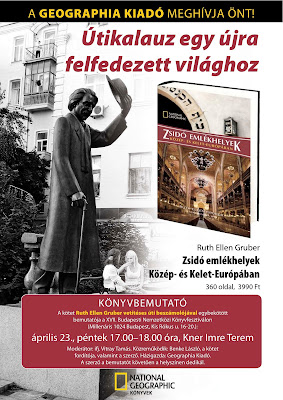
Heavy rain, alas, washed out my book event today in Budapest promoting Zsido Emlekhelyek, the Hungarian edition of Jewish Heritage Travel .... it was supposed to have taken place in an open-air courtyard of Gozsdu udvar, a long series of connected courtyards that leads from Kiraly street through to Dob street.

For the past few days, Gozsdu udvar was the scene of a book and crafts fair that was part of Budapest's annual summer Jewish festival.

With the weather threatening, the publisher, Geographia kiado, organized another venue for the event -- a slide-illustrated talk by me -- in the upstairs cafe of one of the main branches of the Alexandra book shop, just around the corner from the Dohany St. synagogue.

About a dozen intrepid souls found their way to the new venue, and the presentation was a much more intimate experience than anticipated....

Still, people were very interested -- and the publisher says the books has been selling well, comparable to sales of a paperback novel!

Budapest Jewish summer festival celebrates its Bar Mitzvah

 Part of the festival in 2009. Photo (c) Ruth Ellen Gruber


Adam Lebor in Budapest writes a nice piece in the Economist online about the annual Budapest summer Jewish culture festival celebrating its 13th edition -- its bar mitzvah, so to speak.

The festival opened last night with a magnificent concert by the Boban Markovic Orchestra, the world's best known Serbian gypsy brass band ensemble, in the Great Synagogue on Dohany Street in downtown Pest. The synagogue, which holds 3,000 people, is the centre of Jewish life in Hungary. The synagogue was built in the mid-19th century in a neo-Moorish style and has been beautifully restored to its former glory. Playing to a packed house the orchestra kicked off with a rousing rendition of "Hava Nagila", probably the best known traditional Jewish song. The thumping Balkan beat soon had even dowager grandmas clapping along. The Boban Markovic Orchestra is the latest in a long line of renowned musicians to perform here: a century ago both Franz Liszt and Camille Saint-Saëns played the synagogue's organ.It was an interesting choice to open a Jewish cultural festival with a Serbian gypsy band. Partly because of their shared history of persecution, Jews and Roma often feel a kind of kinship. But despite the glorious life-affirming emotion of hearing "Hava Nagila" inside the synagogue, there was a poignant aspect to the concert, for this corner of Dohany street is a haunted place. The small Jewish cemetery behind the main hall houses the remains of perhaps 2,000 people who died of sickness and starvation during the winter of 1944-45 as the Hungarian Nazi Arrow Cross ran wild and the Red army steadily advanced, until the ghetto was finally liberated in January 1945.

On Monday, the festival features a presentation of Zsido Emlekhelyek, the Hungarian edition of my book Jewish Heritage Travel. I'm due to give an illustrated talk about Jewish heritage in Europe.

Hungarian edition of Jewish Heritage Travel presentation


The new Hungarian-language version of my book "Jewish Heritage Travel" -- Zsido Emlekhelyek -- will be featured during the book bazaar of the annual summer Jewish festival in Budapest.

I am scheduled to give an illustrated talk about the book on August 30, at 4 p.m., in Gozsdu Udvar.

Come one, come all!

Budapest -- Eating Jewish

 Flodni advertised at Cafe Noe. Photo (c) Ruth Ellen Gruber

Here's a repost of an article I've written on  trends in Jewish eating in Budapest -- mentioning old classics (like the Fulemule restaurant and its six types of solet) as well as nouvelle places such as Koleves and Spinoza.

By Ruth Ellen Gruber (May 12, 2010)
BUDAPEST (JTA) -- Rahel Raj calls herself a 21st-century Yiddishe mama. The daughter of a rabbi and mother of a toddler, she and her family run a pair of popular Budapest bake shops that specialize in Jewish pastries such as flodni, a calorific confection of layered nuts, apple and poppy seeds that is one of the symbols of local Jewish cuisine.
"A modern Yiddishe mama is not someone who sits in a chair and says, 'Eat!,'" said Raj, a slim 29-year-old with long, dark hair. "I like to dress up, I have a profession, I have a baby -- but on Shabbat I serve a four-course Friday-night meal."
Raj is part of a burgeoning Jewish food scene in Budapest that’s making an impact on restaurant menus in the city and on the way Hungarian Jews eat at home. In addition to her pastry business, Raj writes a column for a local Jewish magazine and two years ago anchored a 10-part Jewish cooking series on a Hungarian TV food channel. On the show, Raj prepared dishes with several local Jewish cooks to demonstrate how old-style traditions now coexist with new forms of culinary practice, as Jews use food both to connect with their roots and reflect a contemporary Jewish lifestyle.
One of her guests was Andras Singer, whose award-winning Fulemule restaurant goes heavy on cholesterol-laden recipes handed down from his mother and grandmother. They include stuffed goose neck, chopped liver, spiced goose fat and six types of solet -- the Hungarian version of cholent, the slow-baked dish of beans and meat traditionally served on Shabbat.
But Raj also featured a young Jewish working mom who prefers to feed her family salads and Israeli favorites such as hummus and pita, which have become popular and easily available in Budapest in recent years thanks in part to an Israeli-run chain of hummus bars downtown.
Another guest was the influential Jewish food writer Eszter Bodrogi, who goes by the pen name Spicy Eszter. Bodrogi, who is in her late 30s, has helped spark new trends in Jewish at-home eating with a popular food blog and lavishly illustrated cookbook, "Spice and Soul."
Her message is that contemporary kosher (or kosher style) cooking can be elegant, easy, healthy and fun.
"Things are really different today," Raj said. "We want modern, lighter, quicker versions of the old traditional recipes -- using olive oil, for example, instead of goose fat. Or making gefilte fish with salmon, flavored with orange. Or instead of solet, maybe serving a barley risotto with smoked duck."
 [...]
Read Full Article at JTA web site

Budapest -- Shameless Self-Promotion!


By Ruth Ellen Gruber

I can't help it. I love to see my books piled up in nice displays in book stores or prominently positioned in the window. About a week after the book launch of the Hungarian edition of Jewish Heritage Travel, I found "Zsido Emlekhelyek" in almost every book store I chanced on in Bpest.


Budapest -- Book launch a big success!


There was an overflow crowd at the Budapest International Book Festival for the official launch of Zsidó emlékhelyek Közép- és Kelet-Európában -- the Hungarian edition of "Jewish Heritage Travel." It was really great to see so many people -- and I was gratified that most of them were people I didn't know!

We had some technical problems setting up the projector, which delayed the start of the event -- my photo-illustrated talk about Jewish heritage sites around the region. And also, the book's editor at Geographia press, who was supposed to moderate the event, wasn't there -- he got stuck in New York because of the volcanic ash cloud.....

Still, it went off well, and the audience I'm sure would have stayed much longer than the allotted hour.... 

I'm told that even though the book is not yet in most stores, there is a lot of buzz about it, and the publishers are thinking about having a few more events, which would run longer and enable more discussion with the audience.

This interest was certainly demonstrated today -- the book is a handsome, hardback edition and costs the equivalent of $20 a copy -- there were lots of sales during my book signing: one man bought four copies! And I'm told there will be articles and reviews in the press here.

I want to thank all involved for taking on the project and bringing out this edition!

Me with the book's translator, Laszlo Benke, after the signing

Hungary -- Book launch today

https://blogger.googleusercontent.com/img/b/R29vZ2xl/AVvXsEhFzo_CvamiSrpWhncXqc09g4Pnlqk25nn1gpJmda1ZCsJHpim1i7Ym308aKNewFv45Qt5rp2tqk5F5NvotEMJaUCEJjgqqAO4l1qU1luAbmoQEFdvLslVGxhRMf3-VALqrE6Q7BgDLvUY/s1600/JHT-hungarian.jpg


Today is the book launch for the Hungarian language edition of Jewish Heritage Travel at the Budapest International Book Festival..... I'm interested in seeing who turns up for my presentation.

Yesterday I attended the opening -- hundreds filled the venue's main theater to hear a "conversation" with Amos Oz, and then see Oz receive the festival's Grand Prize from Budapest Mayor Gabor Demszky.

Israel is the "country of honor" for the festival -- somehow my book (which doesn't touch Israel) is on the program as part of that!

Hungary -- Jewish Heritage Travel Hungarian edition to be launched April 23

For anyone in Budapest April 23 -- the launch is at the Budapest International Book Festival, Kner Imre terem, 5 p.m.

Budapest -- My latest Centropa column, a guide to the Seventh District

In my latest travel column for Centropa.org, I provide a guide to some of the restaurants and cafes I like to patronize in Budapest's new "bar vortex" -- the former Jewish quarter. Venues I profile include the cafes and restaurants Siraly, Szoda, Szimpla, Dupla, Szimpla kert, Carmel (kosher), Hanna (kosher), Spinoza, Kadar, Barladino -- and more.

By Ruth Ellen Gruber
BUDAPEST -- The last time I wrote about Budapest on Centropa I provided an itinerary of Jewish sights and resources, most of them in and around the city's Seventh District, the old downtown Jewish quarter anchored by three grand synagogues forming a so-called "Jewish triangle."
That was eight years ago, and the former Jewish quarter still had the reputation of being one of the city's poorest inner districts. There were some signs of incipient gentrification, but World War II bullet holes pocked many crumbling facades, vacant lots yawned, and the grimy streets were dark and uninviting.
A lot has changed since then. Much of the District is still neglected. But already at the end of 2007 the New York Times ran a travel story called "Out of Darkness, New Life" that described how the district's "history and recent rise to trendiness" evoke "comparisons to the Lower East Side of New York." A recent issue of Time Out Budapest magazine went even further, terming the Jewish quarter a major city "bar vortex."
In fact, the district burgeons with new cafes, clubs, bistros and wine bars that attract a young, hip -- and often Jewish -- crowd. At the same time, though, this type of growth has been paralleled by controversial urban renewal projects that have seen many old buildings torn down and replaced by rather soulless modern structures.
A citizens group, OVAS, has been formed to lobby for the protection of what remains -- particularly in light of real estate corruption involved in some of the development schemes. The Mayor of the Seventh District himself, in fact, was jailed last year on suspicion of bribery and abuse of office related to property transactions.
I've maintained a small apartment in the Seventh District for more than a decade. Though I only spend part of my time here, I've been observing the changes in the quarter up close; after all, it's my neighborhood.
In particular, I enjoy the new venues and Jewish haunts that have nothing to do with a nostalgic sense of a vanished past but everything to do with how Jews in Budapest -- and particularly young Jews in Budapest -- are experimenting with ways to build a lively present and, one hopes, a sustainable future.
With this article, I would like to introduce readers to some of the haunts in and around the Jewish quarter that I tend to frequent: whether for breakfast cappuccino or afternoon espresso, for an inexpensive lunch, or for dinner or late night drinks and conversation. Or simply as somewhere to sit and use the free WiFi internet that most venues in the district seem to offer.
Read full story

Hungary -- Update on Jewish Heritage Travel's Hungarian edition

By Ruth Ellen Gruber

I've been informed that the Hungarian language edition of "National Geographic Jewish Heritage Travel" will be launched at the Budapest International Book Festival in April. (I hope this is true, as the pub date has been postponed already a couple of times...)

For anyone in Budapest around that time, I am scheduled to give some sort of presentation at the Book Fair at 5 p.m. on April 23....The Hungarian edition is being published by the Hungarian branch of the parent publisher, National Geographic.

Each year the Budapest Book Fair honors one country, and this year it will be Israel, with special guest Amos Oz. He and I are to be among about 100 foreign authors from two dozen countries, as well as some 400 Hungarian authors who will be highlighted as part of readings, signings, talks, etc.

The Book Festival takes place in the Millenaris exhibition space.  It draws about 50.000 to 60.000 visitors annually and features tens of thousands of books.

Budapest -- Bob Cohen leads an audio culinary tour


 Me in Froelich's pastry shop in December.

By Ruth Ellen Gruber

I've pointed out a lot of Bob Cohen's wonderful blog posts about food, travel and music and link to his blog, Dumneazu.

But now you can hear him -- Tablet Magazine's audio "Vox Tablet" runs a wonderful 10-minute visit with Bob to two of Budapest's most famous Jewish (or Jewish-style) eateries -- the tiny little Kadar lunchroom on Klauzal ter, and Froelich's kosher pastry shop on Dob utca.

Both are favorites with locals (and a five-minute walk from my apartment).

I vividly remember my first visit to Kadar, back in about 1990 or 1991. I was taken there by the  Peter Wirth, an architect who has carried out restoration work on several synagogues in Hungary and also produced a photographic book on Jewish cemeteries in northeast Hungary. (He won the Europa Nostra award for his restorations of the synagogues in Apostag, in the 1980s, and in Mad, in 2004.)

With Peter that first time, I remember I ordered the solet -- cholent -- with goose leg, a specialty. Kadar is not kosher and even serves sholet with pork. But for many local Jews it is a ritual to go there to eat solet on Saturday. One Saturday lunchtime my brother Sam and I shared a table with a man and his son eating solet -- and we then ran into him later at the Rabbinical Seminary synagogue, where he was the gabbai...

Budapest -- Hanukkah Festival Article

By Ruth Ellen Gruber


Poster for the festival in the door of the Hummus Bar in Kertesz street. Photo (c) Ruth Ellen Gruber


My latest article for the International Herald Tribune/New York Times online is a preview of the Hanukkah Festival in Budapest's old Jewish quarter organized by Marom (with the support of the JDC). I already gave a heads up to the festival on this blog.

Called “Quarter6Quarter7,” the festival, which starts Friday and is the first of its kind, features some 130 events in more than 30 different venues in and around the city’s Seventh District, central Budapest’s first and most important Jewish neighborhood.

“It's a Hanukkah festival, but it’s not just a Jewish event; it’s a festival of the Quarter, of everyone who lives here and visits here,” said Adam Schonberger, one of the organizers. “Living culture is the key, and the district itself becomes a house of culture, where it all is going on.”
Read Full Story

A full program can be seen HERE.  I am taking part in a "conversation" the first night about "why it's good to have a cafe in the Jewish Quarter." Or why not?

Budapest -- JTA Highlights Ovas! and its attempts to save the architectural fabric of the Seventh District old Jewish quarter


 My favorite sign in the 7th district (for a dentist). I hope it doesn't get gentrified away... Photo (c) Ruth Ellen Gruber


JTA's intrepid Wandering Jew, Ben Harris, has written a lively story on the continuing battles over the fate of the Seventh District, Budapest's old downtown Jewish Quarter -- and the district in which  have had an apartment for the past 10 years. (It's a good summary -- and I'm glad to see it because I'm due to speak about the development of the Seventh District at a conference in a couple of weeks in Vilnius...)

He highlights the gentrification but also the activities of Ovas!, an organization founded about five years ago, in attempting to save the dilapidated buildings of the District from unscrupulous developers and the wreckers' ball. Ovas! fights the good fight, but to me the group's failure has been to say "no" to tearing down buildings without putting forward strong, positive alternative strategies.


 Poster for Ovas! outside the Siraly cafe on Kiraly street, Dec. 2008. Photo (c) Ruth Ellen Gruber

I advised Ovas! a little at the start of their activities (they even brought me to brief a city official on my strategic views) and I spoke about the development of Jewish quarters in general at a conference a few years ago organized by Ovas! A number of the people involved (including several of those quoted by Harris in his story) are friends of mine, and I particularly admire the detailed work that Anna Perczel has carried out so passionately over the years. Her book on the buildings of the district is exciting, to read -- but particularly to walk around with.

(See my own JTA story from 2004 about Ovas! by clicking HERE)


Gozsdu Udvar is a controversial restoration/gentrification project in Budapest's Seventh District. In later August/early September, part of the annual Jewish culture festival took place here. Photo (c) Ruth Ellen Gruber

Harris notes some of the corruption involved in the development of the District (fast becoming one of the city's trendiest neighborhoods for cafes and pubs). Many of the developers involved are Israeli.

Gyorgy Hunvald, the mayor of District 7, which includes the Jewish quarter, was deeply involved in selling off historic properties and allegedly making buckets of cash in the process. Hunvald was arrested in February and is now in jail facing charges of bribery and abuse of office.

Perczel sketched out a mind-bogglingly complex story of how investors, developers and the authorities in District 7 colluded to sell off properties, move people out of their homes, and tear down historic buildings for redevelopment. Some aspects of the corruption she describes border on the comical, as when a document that the district was obliged to take into account in formulating its development plan was declared secret and sealed for 15 years.

         Read full story at JTA web site


I began writing about these battles nearly 10 years ago, around the time that I got my apartment, when the local government in the Seventh District (local administrations in Budapest have more power than the city-wide administration) had drawn up plans to punch a pedestrian walkway, the "Madach Promenade", through the district.

When I wrote a "Letter from Budapest" on the issue for Business Week, gentrification of the area was just beginning, but  issues had already festered for years -- actually, for nearly a century. Planners had dreamed of building a new "Madach Avenue" through the district -- and in the 1930s had gotten close: they tore down the so-called Orczy House, a rambling center of Jewish life in the city, and in its place built a brick apartment complex with a huge archway that was to be the gateway to the new Madach Avenue. World War II put an end to these plans.
The Madach Promenade, in fact, is the latest incarnation of a grandiose dream that city planners have tried to implement at intervals over the past century. The failures left the district in limbo, compounding damage done by war and communist-era neglect. Three years ago, architect Andras Roman singled out the Madach plan as an example of how a bold but misplaced vision contributes to urban blight. In ''The Tragedy of an Avenue,'' which appeared in a Budapest cultural journal, Roman traced the failures to the city's behavior as a living organism. City planners, he wrote, ''didn't realize that a city wants to progress by its own rules. It is an inner process that resists the artificial.''

Today, despite all the plans, this process persists. In fact, many locals doubt that the Madach scheme will ever come to pass. But the state of limbo may turn into a fait accompli. Demolition by neglect is a byproduct of inertia, and vacant lots can be more valuable than those with old buildings on them. The Seventh will change, but perhaps not as anyone now envisages.

         Read full Business Week story
 
        Read my 2004 JTA article about OVAS!

Budapest -- Heads Up for Hanukkah Festival


 Lighting menorah at concert, Hanukkah 2008. Budapest. Photo (c) Ruth Ellen Gruber


The old Jewish quarter in Budapest, in the city's inner Districts 6 and 7, will be hosting a big festival throughout the eight days of Hanukkah -- the evening of Dec. 11 through Dec. 19. The main sponsors are the JDC and Marom (the youth group of the Masorti, or conservative, movement). The web site is only in Hungarian so far, and I have not seen the full schedule of events yet, but there are to be concerts, lectures, guided tours, workshops, etc. I've been asked to take part in some sort of conversation on the first night.

About 30 local businesses --cafes, shops, art galleries, pubs, restaurants,  synagogues, the JCC and the Jewish Museum -- are taking part in one way or another.   This is much much bigger than the Hanukkah festival last year, which mainly took place at the Siraly cafe -- I posted a video on this blog of the klezmer/punk/hip hip/fusion party I went to during those events.


That is:

Bálint Ház (JCC)
Bar Ladino
Boulevard és Brezsnyev galéria
Carmel Étterem (kosher restaurant)
Dohány utca synagogue
Dupla (restaurant)
Ellátó
Fröhlich Cukrászda (kosher pastry shop)
Garzon Cafe
Hanna Étterem (kosher restaurant)
Humusz Bár
Kádár Étkezde (lunchroom)
Klauzál Étterem (restaurant)
Klauzál13 Vince Könyvesbolt és Galéria (bookstore and gallery)
Kőleves (restaurant)
Kuplung (club)
Lámpás
M Étterem (restaurant)
Mozaik Teaház és Kávéház (tea house an cafe)
Mumus (club)
Orthodox synagogue
Rs9 színház (theatre)
Rumbach utcai synagogue
Sasz Chevra (Lubavicsi) (Chabad synagogue)
Sirály (cafe)
Spinoza Ház (cafe/theatre)
Szimpla (cafe)
SzimplaKert (cafe)
Szóda (cafe)
Take5
Tűzraktér
Jewish Múseum