Showing posts with label Holocaust memorial. Show all posts

Ukraine -- L'viv Jewish History Design Competition Winning Designs Viewable Online

By Ruth Ellen Gruber

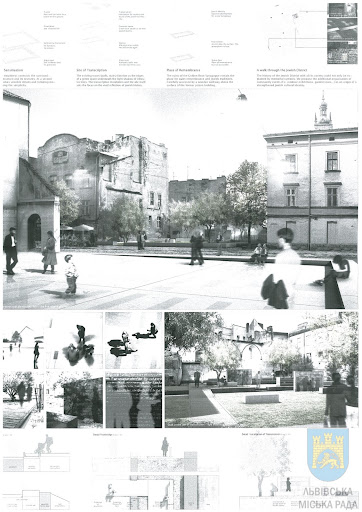
The winning designs -- and all the other entries -- in the competition held in L'viv, Ukraine last year to mark three key sites of Jewish history in the city are now viewable online.

I was on the international Jury for the competition, and I described some of the process in a blog post here last December. Our brief was to consider some 70 designs sent in  from 14 different countries for projects marking three key sites, taking into consideration the following stated criteria:
The competition has two distinct, but interconnected purposes. First, the competiton seeks to respond to the growing awareness of Lviv's multi-ethnic past by contributing to the rediscovery of the city's Jewish history and heritage through creating public spaces dedicated to the city's historic Jewish community. Secondly, the competition also seeks ways to re-design these three open public spaces in such as manner as to improve the quality of life for the contemporary inhabitants and visitors of Lviv.
All the entries were judged anonymously -- we had no idea where they were from or who were the designers.

See all the designs for the Synagogue Square site -- the empty space in the heart of the downtown Jewish quarter where three now destroyed synagogues once stood -- by clicking HERE.

The winning design for the Synagogue Square site was bFranz Reschke, Paul Reschke, Frederik Springer Germany, based in Berlin, Germany.


See all the designs for the Besojlam Memorial Park, or Jewish cemetery, site by clicking HERE.

The first prize went to a design by Israeli designer and landscape architect Ronit Lambrozo. You can see that HERE.


See all the designs submitted for the site of the Janivski death and labor camp memorial by clicking HERE.

The first prize went to a dramatic but understated design by Ming-Yu Ho, Ceanatha La Grange, Wei Huang of Irvine, California.


Macedonia -- New Holocaust Museum Opens

By Ruth Ellen Gruber

There have been several articles about the opening of the new Holocaust Museum and Memorial in Skopje, Macedonia last week -- the opening marks an important step in coming to terms with the past and also was made possible by a landmark decision on post-Holocaust compensation.

The Forward writes:

The inspiration for the center came from Ivan Dejanov, president of the Macedonian Israeli Friendship Association, and its implementation has been led by principal consultant and Holocaust scholar Michael Berenbaum and by Victor Mizrahi, honorary consul of Israel in the Republic of Macedonia. It became possible, however, only with the enactment of the Law on Denationalization, which allows for restitution of money and property rights of Jews, even those without living heirs. The Macedonian government allocated 17 million euros to the Holocaust Fund for the Jews of Macedonia, and this eventually went toward the completion of the center and helped in the construction of the country’s only synagogue, in 2000. “It is almost unprecedented for a government to have acted in this way,” Mais said. “It’s an exemplary phenomenon.”
 It says:
The official celebrations marked only the first phase of the center. A special children’s museum will open in the complex in March 2012, to be followed by the permanent exhibition, in March 2013. The completion of all phases of the project coincides with “Skopje 2014,” a $273 million initiative to transform the city into a competitive European capital and rebuild its infrastructure after a 1963 earthquake that destroyed about 80% of the city’s architecture.

 There are about 200 Jews in Macedonia -- I was present at the inauguration of Skopje's little synagogue in 2000 and have posted about other efforts to restore Jewish heritage.

My article on Holocaust memorials


 Budapest -- Holocaust memorial museum and education center. Photo (c) Ruth Ellen Gruber

I have a brief article on Holocaust memorials in post-communist Europe, part of JTA's series related to the 20th anniversary of the fall of communism.


By Ruth Ellen Gruber, Oct. 30, 2009

ROME (JTA) -- Under communism, Jewish suffering in World War II generally was treated as a footnote to the overall losses in what the Soviets called the "Great Patriotic War."

Public monuments existed at some Holocaust sites in Eastern Europe, such as Auschwitz, the Paneriai forest near Vilnius where at least 70,000 Jews were killed, and Babi Yar, where tens of thousands of Jews were killed in ravines outside Kiev. But these usually commemorated generic "victims of fascism" and did not acknowledge the involvement of local collaborators.

Since the fall of communism 20 years ago, however, a host of new Holocaust memorials have gone up in post-communist states while and Communist-era monuments have been revamped by state authorities, local civic groups and Jewish organizations, giving the Jewish tragedy of World War II more prominence.

The new memorials range from simple plaques to modest monuments to huge memorial complexes, such as the monument at the Belzec death camp. A joint project of the Polish government and the American Jewish Committee, the monument was inaugurated in 2004 by the Polish president.
Some new sites, such as Belzec and the state-run Holocaust memorial center in Budapest, which also opened in 2004, include museums or educational facilities.

In other cases, including at Babi Yar and Paneriai, new inscriptions or components have been added to provide more accurate information and context in order for the memorial site to teach and inform as well as commemorate.

This can become contentious if, for example, the new inscriptions make reference to local collaboration in the killing of Jews.

"After the problem of funding, the hardest part of getting monuments and memorials erected has not been getting some kind of general consent, but it has been working out the specifics of the design and especially the language on the inscription," said the president of the International Survey of Jewish Monuments, Samuel Gruber, who has written about Holocaust memory and consulted on Holocaust monument projects.

"Most older memorials have been very general in their language, so much so that it is often hard to figure out what events are being commemorated, and rarely can one learn about who did what to whom and when,” he said.

This remains a concern, even with monuments whose positioning and design make them prominent. Some memorials form a striking symbolic presence, but provide little or no information as to what they commemorate. Visitors are presumed to know already what they represent.

In the heart of the Slovak capital Bratislava, for example, a chiseled image of a destroyed synagogue now serves as a Holocaust memorial. But other than the word "Remember," no information is provided on how the wartime fascist state collaborated with the Nazis in killing most of Slovakia's 135,000-strong prewar Jewish community.

Likewise, in Sopron, Hungary, a small but powerful sculptural monument depicting empty clothing hung outside the Auschwitz gas chambers stands near an abandoned synagogue. The memorial bears Hebrew lettering and the Sh’ma prayer, but no further information.

"How can one remember what one doesn't know?" Gruber said. "How can one 'not forget' what is never fully discussed or taught?"

On Slovakia’s Holocaust Memorial Day, Sept. 9, Slovak Prime Minister Robert Fico presided over the dedication of a memorial to Slovaks who helped rescue Jews at the time of the anti-Nazi Slovak National Uprising in 1944.

Funded by the Israeli Chamber of Commerce in Slovakia and several private sources, the memorial was built in the town of Zvolen next to the mass gravesite of Jews who were killed by the Nazis. It also includes a digital information point.

"This represents a different way of presenting Slovak national history that is at the same time a rejection of the [Nazi-allied] Slovak national puppet state of Josef Tiso," said Rabbi Andrew Baker, the American Jewish Committee's director of international Jewish affairs who has advised on Holocaust memorial projects in several countries. "Fico deserves credit for doing this, and he also speaks emotionally about the importance of Holocaust education in his country."

Though flawed at times, the memorials serve an important purpose.

"Memorials have a permanent presence," said Warren Miller, chairman of the U.S. Commission for the Preservation of America's Heritage Abroad, which has been involved in Holocaust memorial projects in Latvia, Romania, the former East Germany and other countries. "Going to a powerful memorial will help people want to learn more."

Romania -- New Holocaust Monument in Bucharest

By Ruth Ellen Gruber

A new National Holocaust memorial, commemorating Jews and Roma killed in the Shoah, will be dedicated in Bucharest on Thursday.
President Traian Basescu laid the cornerstone for the memorial in 2006 and is expected to attend the dedication. The Romania Ministry of Culture, Religious Affairs and National Heritage described the monument, designed by Peter Jacobi, as "a contemporary expression of a memorial, the bearer of a message, a visible sign, an active space with which the public can interact freely." It includes five sculptures symbolizing Jewish and Roma suffering, a central memorial site and two installations using tombstones.

Construction of the monument was mandated by an international commission on the Holocaust in Romania, headed by Elie Wiesel, which released a 400-page report in 2004. As many as 380,000 Jews, and thousands of Roma, were killed in the Holocaust in Romanian-occupied territories.

Until now, the only Holocaust memorial in Bucharest was one erected by the Jewish community in 1991 in front of the main Choral Synagogue.


Holocaust memorial in front of the Choral Synagogue, Photo (c) Ruth Ellen Gruber

Sam Gruber has posted a detailed article on Holocaust memorials in Romania on his blog.